


Have you ever been told that the church only recently started caring about the child in the womb? That the topic of abortion is a modern fight that our parents or grandparents invented recently for political reasons?
If we only look at our own century and ignore context, that story almost sounds true. However, if we roll back time to the first century, we will find that the first Christians also weren’t born into a culture that prized the unborn; they were born into a Roman world that treated children as household property, that could be sold, aborted, or discarded, and few people in the empire cared to question it.
So today, I would like to roll back the clock, look at that world the first Christians were born into, and see how they responded to the culture around them.
The Common Philosophy of the Roman World
The Roman world was absent from our rights debate. It had household rights, and Roman law still left the rights of the child in the hands of the father. The father of a family had a legal power called patria potestas, “the power of the father.” In the old law, that power even included a right of life and death over his children. By the time of the empire, that extreme right was more a symbol of power than daily practice. However, the idea behind it was still very much alive: the child belongs to the father, and the father decides what happens, regardless of the mother’s desire.
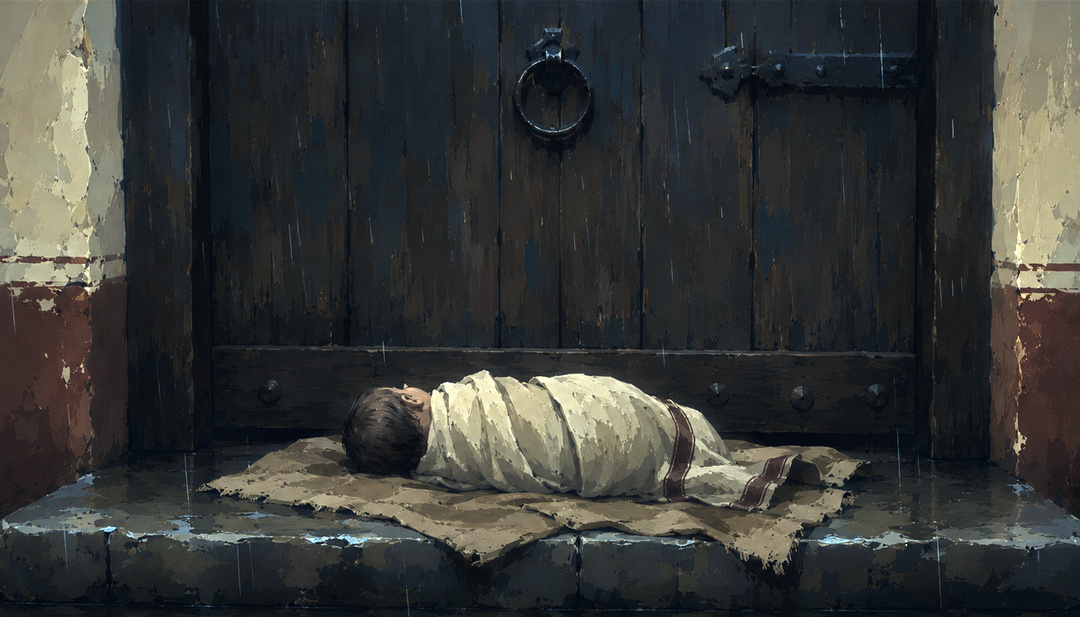
So what did that look like in real life? The most common occurrence was abandoning newborns on a doorstep. Girls, the poor, the deformed, and the illegitimate were especially vulnerable to this cruel fate. The Romans referred to it as “exposure.” Some babies died of cold and hunger. Some were taken up into slavery or worse. Roman law did not treat it as murder. It was a familiar cultural habit, not a crime. Some voices called it inhuman, but the world was indifferent. So exposure became a common household option when a child was not wanted, though it was not what every household did.
Most infants were “terminated” after birth due to there being no way to determine the wellness or gender of a child before birth. However, abortion was still an option in the case of those who did not want a child at all. Ancient medical writers described many drugs that were used to stop an active pregnancy. Pennyroyal, rue, myrrh, ecballium elaterium, cyclamen, and many, many more “medicines” were also used to abort a pregnancy, but the most famous example is silphium. The physician Soranus listed the juice of silphium, Cyrene’s famous spice and medicine, among substances some used to prevent conception or destroy what was already conceived (Gynecology 63). Its ability to act as a contraceptive, abortifacient, and aphrodisiac made it extremely desirable. The plant became so valuable and commonly known that Cyrene put it on the face of its coins. Around the same period, Peter and Paul were put to death for their faith; Pliny the Elder records that silphium had grown so scarce in Cyrene that the last stalk found there was sent to Nero (Natural History 19.15). Though silphium was harvested to extinction by the end of the first century, the other methods of abortion remained, and it was still accessible and regularly practiced by those in the Roman Empire.
That was the world the first Christians were forced to walk in. It was not a neutral world. The issue of abortion was already decided. It was legal, marketed, socially acceptable, and actively used. So the question is, what did the Christians do about it? Did they say anything, or did they remain silent?
The Teaching of the Early Church
We find that Scripture had already spoken a different word to the Christians. The Old and New Testaments contain glimpses of human life before birth, and its unseen value. “Thou hast possessed my reins: thou hast covered me in my mother’s womb. I will praise thee; for I am fearfully and wonderfully made” (Psalm 139:13-14). “Before I formed thee in the belly I knew thee” (Jeremiah 1:5). When Mary came to Elisabeth, “the babe leaped in her womb” (Luke 1:41). These verses, alongside the teachings of the Apostles, taught the early church that the sixth commandment did not wait for a birthday: the “Thou shalt not kill” rule started in the womb.
One of the oldest Christian teaching manuals we have is the Didache, which claims in its opening lines to be “the Teaching of the Twelve Apostles,” a collection of teachings that the church should unanimously agree on because they were what the Apostles themselves taught as they preached the gospel from city to city. It was composed around the end of the first century, as the Apostles began dying out, to preserve the Church’s Apostolic standards. Though it is not Scripture, it is a window into what ordinary believers were already being taught about the issues of their day among their congregations.
The Didache circulated among several early Christian communities all over the known world and was influential enough that its teachings were repeated and used to develop later church manuals. Even centuries after it was written, church leaders were still familiar with it, sharing it in their churches, and regarded it as a beneficial resource for teaching doctrine.
The Didache opens with a beautiful line that still rings true today: “There are two ways: one of life and one of death, but a great difference between the two ways.” Then, shortly after, as it begins to lay out the rules of the church, in the same breath as it lists the command against murder, it says, “You shall not murder a child by abortion nor kill that which is born” (Didache 2.2). Abortion and the killing of a newborn infant by exposure are placed in the same sentence. Both were under the same command, because they were considered the same sin. This was not how the Roman Empire talked, but it is irrefutably how the church did. The anti-abortion stance has been a Christian counter-culture movement right from the start.
When the Didache lists the way of death, in a later section it once again includes “murderers of children, destroyers of the handiwork of God” as those who participate in the ways of Death. (Didache 5). The unborn child is not seen as an accident of biology, but as the work of God. The Roman household has no right to uncreate what God has created. The Epistle of Barnabas says nearly the same thing, and it is also mentioned regularly among the Apostolic Fathers. And this we will see shortly.
The church did not wait for the culture to become decent. It taught converts right away that the world’s stance on abortion was clearly the way of death. And those who follow death are not following the way, the truth, and the life.
The Witness of the Church Fathers
That first prohibition by the Didache was not softened over time. As we said, the church leaders who followed also agreed:
The Epistle of Barnabas, which claims to be written by the Apostle Barnabas, a companion of the Apostle Paul, deals with this issue directly. Although the early church did not see this writing as Scripture, they did believe it was truly written by Barnabas. In Barnabas 19:5, he says clearly, “Thou shalt not slay the child by procuring abortion; nor, again, shalt thou destroy it after it is born.”
Athenagoras wrote around AD 177 to the Roman emperors themselves, and he answered the charge that Christians were murderers in A Plea for the Christians, chapter 35, by saying, “when we say that those women who use drugs to bring on abortion commit murder, and will have to give an account to God for the abortion, on what principle should we commit murder?” Athenagoras, even when talking to the unsaved political leaders deeply rooted in Roman culture and philosophy, was clear about the Church’s official stance. “Abortion is murder”
Tertullian, around AD 197, wrote it even more plainly: “In our case, a murder being once for all forbidden, we may not destroy even the fetus in the womb, while as yet the human being derives blood from the other parts of the body for its sustenance. To hinder a birth is merely a speedier man-killing; nor does it matter whether you take away a life that is born, or destroy one that is coming to birth. That is a man which is going to be one; you have the fruit already in its seed” (Apology 9:8)
If you continue down the line of history, you will find a consistent teaching from Church leadership that abortion is wrong. This begs the question. If the Bible does not explicitly forbid abortion, then why did the early Church take such a strong counter-cultural stance as they spread Christianity to the world? Well, if we take The Didache at its word, then all the Apostles agreed and preached that abortion was murder. Though we could never know with certainty, the fact that it was a unanimous teaching means Jesus likely discussed it with them at some time. It was never a topic of debate for believers because they assumed it was obvious. Killing is always wrong. This does not mean every Christian always obeyed. Obviously, teachers do not write against a sin nobody commits. So, although it was the clear teaching, it was still difficult for some, especially those coming into the church from non-Jewish culture.
So then why do people think it became an issue for our religion over the last generation or two? Well, something changed. Before 1973, the official stance in the United States was that abortion was illegal because it was wrong. And when culture tells you something is wrong, you don’t need to preach on it as much. However, after Roe v. Wade, the nature of the discussion changed. It was no longer about maintaining the cultural standard. Being an abortion abolitionist once again meant being counter-culture.
The Way of Life Still Before Us
The Didache said there are two ways. That has not changed.
One way treats a child as a problem to be managed. That way is old. It was common in Rome. It is still with us today. The other Way treats a child as a creation already under God’s care, as a piece of His handiwork, and a neighbor we are already to love. And how are we to kill those whom we are to love? That Way was strange when the church first walked into the Roman world. It will still be strange to some today.
So, how can we walk the Way of Life now? Speak the truth. The church did not invent this belief yesterday, and it did not borrow its standard from an ancient decent and moral culture. Refuse the world’s calculation. An unborn child is not an interruption or inconvenience; they are a being whom God is knitting together, an image bearer of the divine, and a living person.
But also let’s not forget that it is not enough to condemn what the world does to the unborn if we will not help the mother who is afraid. The same Didache that forbids murder also taught, “You shall not turn away from him that is in want, but you shall share all things with your brother” (Didache 4.8). So remember to comfort those afraid of the unknown, and support those who need it most.
Closing Thoughts
The earliest Christians understood that following Christ meant choosing a different Way from the world around them. If every human life is the handiwork of God, then neither convenience, fear, poverty, nor cultural acceptance could determine whether that life has value.
That is still the choice before the church today. We should not oppose abortion merely because it violates our politics or traditions, but because we believe human life belongs to God.
I hope this write-up is helpful for anyone searching for an answer on this topic. For anyone who may be afraid of an unknown before them, know that many stories of Scripture start with an unknown. Abraham didn’t know where he was going. Joseph didn’t know why he was sold into Egypt. Ruth didn’t know what awaited her in Bethlehem. David didn’t know how long he would be on the run. Daniel didn’t know that the lion’s mouths would be shut. Peter didn’t know what would happen when he stepped out of the boat to walk on the sea. Though all these situations carried fear. God got them through it, and their stories still encourage many alive today. So maybe your story will, too.